Comparisons
Concrete wall vs stone wall: which to choose?
These are two different builds that can end up looking similar. A stone wall is masonry, made piece by piece on site by a stonemason. A precast concrete wall is a system of panels and posts produced in a factory and dry-assembled — and several textures imitate stone. The decision usually comes down to three points: budget, lead time and whether you want real stone or the look of it.
What each solution is
Stone wall
Natural stone — granite, limestone, schist — laid on site, dry or with mortar. Each piece is selected and adjusted by hand, on a foundation footing. It is stonemasonry: the result depends on who does the work and every stretch is unique.
It is the oldest solution and the most expensive. It is also the one that ages best: a wall of well-dressed stone still looks right fifty years later.
Precast concrete wall
Reinforced concrete panels that slot into the grooves of posts, forming 2 m segments repeated along the perimeter. C35/45 concrete reinforced with Ø3 mm welded steel mesh + glass fibre, vibro-compacted at the factory. On site the holes are dug, the posts are plumbed and the panels are slotted in; the only concreting is the filling of the holes.
There are dressed stone, rustic stone and river pebble textures. The colour comes from the cement — grey or white — and for that reason it does not peel.
Free quote, with no obligation. Tell us the municipality, the length and the height — we reply with a figure.
Criterion-by-criterion comparison
Each line brings its own conclusion. Concrete does not always win, and where it does not it is written down.
| Criterion | Stone wall | Precast concrete wall | Criterion conclusion |
|---|---|---|---|
| Price | Natural stone from 250 €/l.m.; stone masonry 256.31 €/m³, material and labour | Material from 25 €/m² plus installation 59–79 €/linear m, excluding VAT | ConcreteThe difference is one of scale, not of detail: stone starts from a level several times higher and rises with the type of stone and the finish. |
| Appearance | Real stone: depth, natural variation, no two pieces alike | Moulded texture; the pattern repeats from panel to panel | Stone wallHere stone wins and there is no point pretending otherwise. A mould does not reproduce the variation of natural stone seen up close. |
| Lead time | Continuous wet work; the pace depends on the site and the curing stages | 20–30 m per day under normal conditions, with the piece already made | ConcreteThat is the most concrete advantage of precast on a long perimeter or against a fixed date. |
| Consistency along the wall | Each stretch is unique; the quality follows the hand that made it | Repeated geometry, controlled in the factory | ConcreteIf you want the same appearance from start to finish, the modular system delivers that by construction. If you want variation, it is a disadvantage. |
| Foundation | Normally a continuous reinforced footing along the whole alignment | No strip footing: one 300 × 300 × 800 mm hole per post, 800 mm buried | ConcreteLess excavation, less concrete and less time before the wall starts going up. |
| Repairing damage | Stonemason’s work; matching the stone and the joint is difficult and the repair shows | The affected panel comes out and another goes in, without dismantling the rest | ConcreteModularity only pays for itself when something goes wrong — and that is when you notice it. |
| Future changes | Opening a gate or changing the layout means demolishing and rebuilding | The necessary section is dismantled and reassembled | ConcreteRelevant on plots that are still to be built on or divided. |
| Thickness and space taken up | The stone masonry reference is for pieces up to 50 cm thick, with one exposed face | Panel of 30 mm and post of 120 × 120 mm every 2 m | ConcreteOn an urban plot the difference in thickness gives back usable area along the whole perimeter. |
| Cost breakdown | In the reference quoted, the material is 57.85 €/m³ and the labour 97.88 € (official) plus 95.55 € (helper) per m³ | Most of the cost is the factory-made part; the labour on site is installation | ConcreteWith stone, most of the cost is manual labour — it is the item that rises the most and the one that depends most on finding someone to do it. |
| Maintenance | Cleaning; with mortar, repointing the joints over the years. Ten-year maintenance cost stated in the reference: 17.94 €/m³ | Washing; optional painting, recommended to seal the surface | DependsBoth are low-maintenance solutions. Neither of them requires annual work. |
| Durability | Very high when properly executed | Service life stated in the product data sheet: over 40 years; concrete does not rot or corrode. Water absorption ≤ 6 % and reaction to fire A1 | DependsOn this timescale both solutions hold up. We have no decades-long measurements of our own to say which lasts longer, and anyone who claims otherwise without them is guessing. |
| Taxable asset value | Local stone adds value and is sometimes required by the municipality | It adds no property value; it is a functional fence | Stone wallIn a historic area or where municipal restrictions apply, stone may be the only option allowed. |
Delivery is not included in these prices. Delivery of the material to the site is quoted separately, by municipality and volume.
The three points where the decision is made
Quote. This is the most visible difference. Published figures for natural stone in Portugal start at 250 € per linear metre and rise with the type of stone. Our material starts at 25 €/m² and installation at 59 €/linear m. We are not adding those two figures together here: the total depends on the height, the access and the state of the line, and that is what the quote settles.
Lead time. Stone masonry is wet work from start to finish. The precast system installs 20 to 30 metres per day under normal conditions, because the unit arrives ready and the only concrete made on site is that of the post holes.
Stone or stone effect. This is the honest question. If the answer is «I want stone», concrete will not do, however well moulded it may be. If the answer is «I want an opaque, solid wall with a mineral look», then textured concrete answers that for a fraction of the cost.
How to tell the two apart up close
It is worth knowing what you will see when you get close, so there are no surprises after installation. On a textured concrete wall the pattern repeats to each panel: anyone looking will find the same «stone» several times along the run. The joints between panels are straight and horizontal, every 2 metres there is a post, and the whole has a regularity that masonry does not have.
At the distance from which a fence is actually seen — from the street, from the car, from the other side of the garden — it reads as stone. That is why this product works as a perimeter fence and does not work as a decorative wall in a living room.
The stone textures we supply
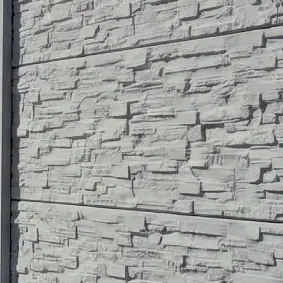
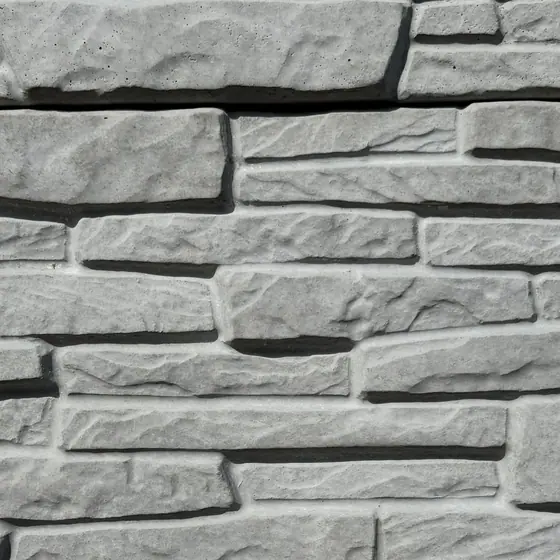
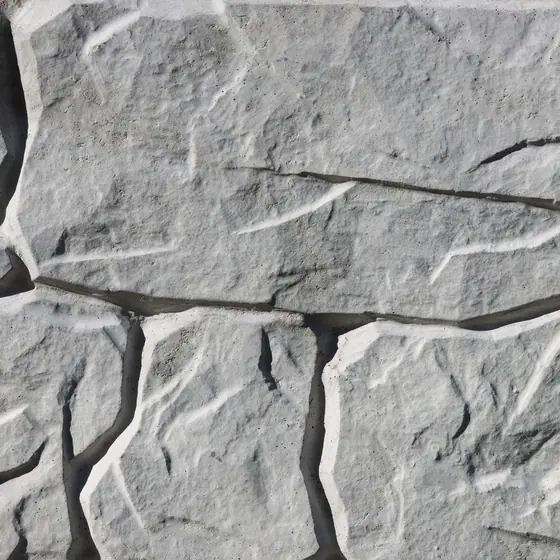
Of the four textures we have in stock, Alpine imitates stone. The other stone textures in the catalogue are produced to order.

What makes the price of each one vary
On the stone wall
- type of stone and distance to the quarry;
- joint fitting and finishing;
- wall thickness and height;
- foundation footing;
- availability of skilled labour — this is the factor that varies the most.
In the precast concrete wall
- the texture chosen and whether it is in stock or made to order;
- height, which determines the panel layers and the post required;
- length;
- lorry access to the alignment and the slope of the plot;
- condition of the line: roots, old fencing, stone in the ground;
- transport and unloading, quoted on request.
Free quote, with no obligation. Tell us the municipality, the length and the height — we reply with a figure.
Frequently asked questions
Can I combine stone and concrete on the same perimeter?
Yes, and it is common: stone posts or low walls at the entrance and the rest of the perimeter in precast concrete. The system fits alongside existing structures, with a minimum clearance of 350 mm.
Does textured concrete fade like paint?
No, because it is not paint. The colour comes from the cement and runs right through the piece. What may happen in the first 2 to 6 months is efflorescence — whitish marks, a natural process in concrete, which comes off with rain or with water and a soft brush.
Is either of the two suitable for retaining soil?
Our system does not: the panels are sized for wind load, not for ground pressure. Nor does a decorative stone wall — retaining a slope requires a calculated structure, whatever the material.
What if I only want stone at the front of the house?
It is a sensible solution and we do not sell all of it: the stone at the front will have to come from a stonemason. We supply and install the concrete for the rest of the perimeter.
Completion
Concrete wall or stone wall: how to decide
Against stone, precast concrete wins on cost, lead time, consistency and ease of repair; it loses on close-up appearance and on heritage value. In other words: if the wall is a perimeter, concrete is the rational choice; if the wall is a façade, stone is still right.
Choose the concrete wall if…
- the quote is the deciding criterion;
- there is a set date or the perimeter is long;
- you want the same appearance repeated along the whole run;
- you want to be able to replace a piece ten years from now;
- it is plot or house fencing, with no structural function.
Choose a stone wall if…
- you want real stone and the budget allows for it;
- the wall is short and highly visible — an entrance, the front of a house;
- there is a heritage context or a municipal requirement for local stone;
- you want to reuse stone already on the plot;
- the variation between sections is intended, not a defect.
Where they are equal
- maintenance: neither of the two requires regular work;
- durability: both last for decades when properly built.
How much it costs in your case
Tell us the municipality, the length and the height. We reply with a price and the lead time for the material — and if the right solution for you is the other one, we say so.
Sources
The third-party figures quoted on this page are not our own estimates. The references they came from are given here so that you can check them.
- Stone masonry wall 256.31 €/m³ and ten-year maintenance cost 17.94 € — professional price generator for civil construction geradordeprecos.info
- Natural stone wall from 250 €/linear m and precast panels 120–180 €/linear m — indicative market values naveganteconstrucoes.pt
Request a free quote
Just leave your name and phone number — that is enough for us to get back to you. If you tell us the municipality, the length and the height, we will reply straight away with a price and with the lead time for the material.
Fields marked with * are required.